

The Core Insight
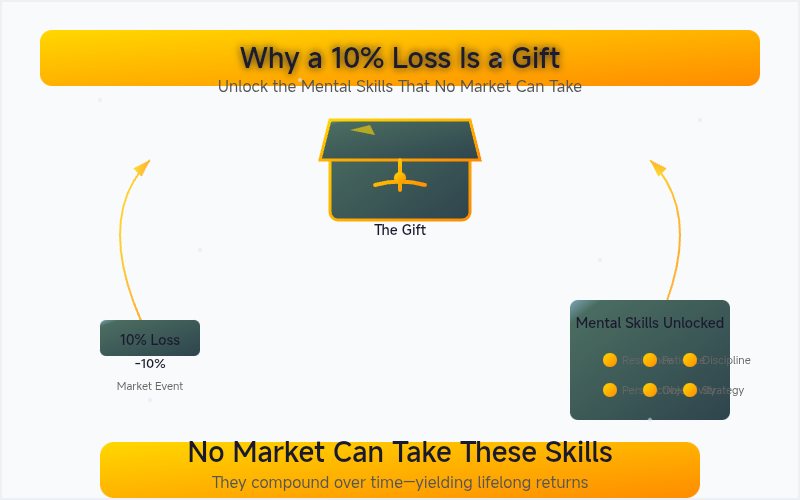
Losing money strips away the physical, but the mental architecture you built to earn it remains. This experience highlights a crucial distinction: assets can vanish overnight, but the cognitive framework and skills used to acquire them are permanent. You realized you lost only 10% of your total worth, separating the transient from the essential. This specific percentage acts as a psychological anchor, preventing the common cognitive trap of catastrophizing where a single event is perceived as an existential threat. By isolating the financial impact from the emotional one, you create a clear runway for recovery that is grounded in data rather than despair.
Furthermore, this distinction challenges the conventional narrative that wealth is purely external. While the dollar amount may fluctuate, the underlying neuro-pathways developed through discipline, strategy, and perseverance remain etched in your brain. These neural connections represent a form of capital that is immune to market volatility, inflation, or theft. The 10% loss, therefore, is not just a financial figure but a reminder that your true wealth resides in your adaptable mind, not in a static bank balance.
Disclaimer
The following content is for informational and educational purposes only and does not constitute financial, legal, or psychological advice. All examples and scenarios are based on generalized concepts and individual experiences may vary significantly. Please consult a qualified professional before making any major decisions. It is important to recognize that while the principles discussed here are based on common psychological and financial frameworks, they do not account for the unique complexities of every individual’s situation. The goal is to provide a lens through which to view adversity, not a prescription for action.
Additionally, the strategies mentioned assume a specific context of calculated risk-taking rather than reckless gambling. The outcomes described rely heavily on prior knowledge, research, and a tolerance for uncertainty. Readers should evaluate their own risk profiles and personal circumstances before attempting to replicate any ideas. The variability of results underscores the need for personalized guidance rather than reliance on generalized internet content.
Key Takeaways
- True wealth is the internal skill set and awareness, not the external accumulation.
- A financial loss can be a powerful catalyst for developing resilience and mental fortitude.
- Understanding the percentage of actual loss versus perceived loss reframes the entire experience.
- The journey to acquiring money builds an invaluable toolkit for future endeavors.
- Adversity serves as a diagnostic tool, revealing the strength and flexibility of your personal systems.
- Financial literacy extends beyond numbers; it encompasses emotional regulation and decision-making under pressure.
Table of Contents
- The Core Insight
- Disclaimer
- Key Takeaways
- Calculating the Real Loss
- The Psychology of Scarcity
- Building Unshakeable Assets
- Actionable Insights
- FAQ
- Conclusion
Calculating the Real Loss
Your story is a powerful lesson in perspective. By framing the loss as only 10%, you shifted the focus from panic to analysis. This calculation protects your ego and allows for rational recovery rather than emotional collapse. The mathematical simplicity of the number serves as a cognitive tool that prevents the mind from spiraling into worst-case scenarios that often paralyze decision-making.
When others lose 90% of their net worth, they often lose their strategic mind. You, however, retained the awareness that allowed you to quantify the damage. This numerical detachment is the first step toward financial resilience. It transforms a chaotic event into a solvable equation, allowing you to apply logic instead of emotion to the problem at hand.
The Psychology of Scarcity
Most people define themselves by their net worth, making loss a direct attack on identity. When the money is gone, they feel erased, believing the person they were is also gone. You recognized that the person who fought to acquire the wealth is distinct from the wealth itself. This realization is the cornerstone of emotional stability, as it decouples self-validation from external validation.
This mental separation is the ultimate defense against scarcity thinking. It allows you to view setbacks as temporary obstacles rather than permanent definitions. The skills you honed remain, ready to be applied to the next challenge. By understanding that your identity is not a ledger sheet, you free yourself from the tyranny of fluctuating market conditions and reclaim your agency.
Building Unshakeable Assets
The true value of the experience lies in the intangible assets you accumulated. These include discipline, pattern recognition, and the ability to navigate complex financial systems. These are the assets no market crash can touch because they exist solely within your consciousness and are not subject to external market forces. Unlike stocks or real estate, these cognitive tools appreciate with use and become sharper through friction.
Focus on converting these soft skills into hard competencies. Document the strategies that worked, analyze the failures, and build a playbook. This transforms a painful event into a foundational chapter of your personal operating system. Treat this documentation not as a relic of the past, but as a dynamic blueprint for future decision-making that reduces the likelihood of repeating errors.
Actionable Insights
Start by journaling the specific skills you used to earn the money. Identify the traits—such as negotiation or risk assessment—that you relied on. Then, create a practical plan to apply these traits to a new venture or investment strategy. This process of extraction and reapplication ensures that the lessons are not lost to memory but are actively integrated into your future behavior.
Treat the 10% loss as the cost of admission for advanced knowledge. Use this data to refine your risk management protocols. The goal is not to avoid future losses, but to ensure they remain small and instructive. By institutionalizing this mindset, you create a feedback loop where every setback makes you smarter and more robust, turning vulnerability into a competitive advantage.
FAQ
Q: How can I stop tying my self-worth to my bank account?
A: Practice daily affirmations that focus on your inherent value and skills. Shift your internal dialogue from “I have” to “I am.” Engage in activities that reinforce your identity independent of financial status, such as volunteering, learning a new hobby, or mentoring others. This helps rebuild the neural pathways that associate your value with intrinsic qualities rather than extrinsic metrics.
Q: What is the best way to rebuild after a significant financial loss?
A: Start with a strict budget and a small, achievable goal. Rebuilding confidence happens through consistent, small wins rather than grand gestures. The compound effect of minor successes recalibrates your relationship with money, shifting it from one of fear to one of strategic engagement. Track these wins meticulously to provide tangible evidence of progress.
Q: How do I protect myself from losing 90% of my assets?
A: Diversification is key. Ensure your wealth is spread across different asset classes and that you have a solid emergency fund to prevent panic selling. Consider implementing a “stop-loss” mentality not just in finance, but in life, by setting boundaries and maintaining liquidity. This multi-layered approach ensures that no single point of failure can dismantle your entire financial ecosystem.
Conclusion
The loss of capital is rarely the end of the story; it is often the prologue. By recognizing the enduring value of your internal skills, you transform a moment of vulnerability into a source of strength. Remember, the person who acquired the money is still within you, ready to build again. This continuity of self is the most powerful asset you possess, as it guarantees that the journey does not end with a balance sheet but rather evolves into a testament of growth and adaptability.
Moving forward, embrace the discomfort of this experience as a forge for character. The resilience you develop here will serve you in contexts far beyond finance, influencing your relationships, career, and personal fulfillment. The ultimate victory is not in recovering the lost capital, but in emerging as a more knowledgeable and disciplined version of yourself, equipped to navigate an uncertain world with greater wisdom and confidence.